Showing posts with label wikipedia. Show all posts

Tuesday, November 23, 2010

Hypnagogia


Hypnagogia (Greek ὕπνος, húpnos "sleep" away" etc.), alternatively hypnogogia, is a term coined by Alfred Maury for the transitional state between wakefulness and sleep (i.e. the onset of sleep). The equivalent transition to wakefulness is termed the hypnopompic state. Mental phenomena that occur during this "threshold consciousness" phase include lucid dreaming, hallucinations, out of body experiences and sleep paralysis.

Threshold consciousness (commonly called "half-asleep" or "half-awake", or "Mind Awake Body Asleep") describes the same mental state of someone who is moving towards sleep or wakefulness but has not yet completed the transition. Such transitions are usually brief, but can be extended by sleep disturbance or deliberate induction, for example during meditation.

imaginea de pe coperta:grzesiek pe deviantart
Hypnagogia pe wikipedia

Wednesday, November 10, 2010

Tax resistance

Tax resistance is the refusal to willingly pay a tax because of opposition to the institution that is imposing the tax, or to some of that institution’s policies.
Some tax resisters refuse to pay all or a portion of the taxes due, but then make an equivalent donation to charity. In this way, they demonstrate that the intent of their resistance is not selfish and that they want to use a portion of their earnings to contribute to the common good.
For instance, Julia Butterfly Hill resisted about $150,000 in federal taxes, and donated that money to after school programs, arts and cultural programs, community gardens, programs for Native Americans, alternatives to incarceration, and environmental protection programs. She said:
I actually take the money that the IRS says goes to them and I give it to the places where our taxes should be going. And in my letter to the IRS I said: “I’m not refusing to pay my taxes. I’m actually paying them but I’m paying them where they belong because you refuse to do so.”

sursa: wikipedia.org

Monday, May 17, 2010

Berlin '45

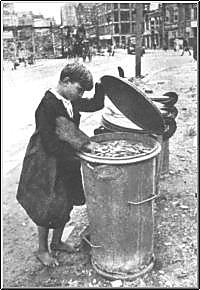
Two new words entered the German vocabulary during 1945:

Hamstern (literally, "to hamster"): This meant to travel into the countryside, in order to exchange possessions for food. Anything from watches and jewelry to blankets and rugs were exchanged for very small amounts of food.

Fringsen: This meant to steal to survive. This word is etymologically based on the surname of Cardinal Josef Frings, a senior figure in the Catholic Church of Cologne, who famously gave his blessing to those who had to steal in order to feed their family.

Friday, May 7, 2010

Magicienii sovietici


În această imagine, Nikolai Yezhov apare alături de Voroshilov, Molotov, şi Stalin vizitând Canalul Marea Albă-Marea Baltică


În această a doua imagine, Yehzov - între timp epurat - a fost eliminat.


"The Great Purge" was a series of campaigns of political repression and persecution in the Soviet Union orchestrated by Joseph Stalin in 1936–1938. It involved a large-scale purge of the Communist Party and Government officials, repression of peasants, Red Army leadership, and the persecution of unaffiliated persons, characterized by widespread police surveillance, widespread suspicion of "saboteurs", imprisonment, and executions. In Russian historiography the period of the most intense purge, 1937–1938, is called Yezhovshchina (Russian: Ежовщина; literally, "The Yezhov Regime"), after Nikolai Yezhov, the head of the Soviet secret police, NKVD.
sursa: wikipedia
"The memory hole" is a metaphor for the alteration or outright disappearance of inconvenient or embarrassing documents, photographs, transcripts, or other records, such as from a web site or other archive, particularly as part of an attempt to give the impression that something never happened. The concept comes from George Orwell's novel, Nineteen Eighty-Four.
sursa: wikipedia

imagini: wikipedia, 1 si 2

Thursday, February 4, 2010

Iţkuîl

http://upload.wikimedia.org/wikipedia/en/9/91/Ithkuil_script.gif
"On the contrary, I think it may turn out that
this rugged mountain range trails off at some point."

Iţkuîl is a constructed human language marked by outstanding grammatical complexity, expressed with a rich phonemic inventory or through an original, graphically structured, system of writing.

The language’s author, John Quijada, presents Iţkuîl as a cross between an a priori philosophical language and a logical language designed to express deeper levels of human cognition overtly and clearly, yet briefly. The many examples from Quijada’s original grammar show that, in the general case, a message would take significantly longer to explicate in a natural language than in Iţkuîl.

Quijada deems his creation too complex and strictly regular a language to have developed “naturally”, but nonetheless a human-accessible language useful for general conversation and literature. No person is known to be able to speak Iţkuîl fluently; Quijada, for one, does not.

The approximate translation of iţkuîl is “an idea/fantasy of a complete purposeful system of complementary speech elements”, or simply “an imaginary language”.

Sursa: Wikipedia

Monday, November 17, 2008

Mamihlapinatapai

Mamihlapinatapai (sometimes spelled mamihlapinatapei) is a word from the Yaghan language of Tierra del Fuego, listed in The Guinness Book of World Records as the "most succinct word", and is considered one of the hardest words to translate.

It describes "a look shared by two people with each wishing that the other will initiate something that both desire but which neither one wants to start."

The word consists of the reflexive/passive prefix ma- (mam- before a vowel), the root ihlapi (pronounced [iɬapi]), which means to be at a loss as what to do next, the stative suffix -n, an achievement suffix -ata, and the dual suffix -apai, which in composition with the reflexive mam- has a reciprocal sense.

(from wikipedia.org)

Tuesday, September 16, 2008

Intifada

"In 1990, 21 Israeli soldiers confessed to frequent repeated brutal assaults against Palestinians. Yishai-Karin reported that Israeli soldiers were exposed to violence against Palestinians during the first weeks of training. The soldiers also expressed feelings of joy when they were given power to instill fear and use physical violence on the Palestinians. One soldier recalls shooting an unarmed Palestinian for no reason, "We were in a weapons carrier when this guy, around 25, passed by in the street and, just like that, for no reason - he didn't throw a stone did nothing - bang, a bullet in the stomach, he shot him in the stomach and the guy is dying on the pavement and we keep going, apathetic. No one gave him a second look,' he said."

"The Swedish branch of Save the Children estimated that, "23,600 to 29,900 Palestinian children required medical treatment for their beating injuries in the first two years of the intifada", one third of whom were children under the age of ten years old."

"Until February 2005, Israel had in place a policy to demolish the family homes of suicide bombers. Due to the considerable number of Palestinians living in single homes, the large quantity of homes destroyed, and collateral damage from house demolitions, it become an increasingly controversial tactic. Families have provided timely information to Israeli forces regarding suicide bombing activities in order to prevent the demolition of their houses, although families doing so risk being executed or otherwise punished for collaboration, either by the Palestinian Authority or extra-judicially by Palestinian militants. The IDF committee studying the issue recommended ending the practice because the policy was not effective enough to justify its costs to Israel's image internationally and the backlash it created among Palestinians."

(text and picture from wikipedia, more here and here)

Monday, June 23, 2008

Despre Factorul Hannibal

Factorul Hannibal e găinaţul care îţi pică pe mânecă atunci cand te duci la o întâlnire importantă. E mama care te sună la ora doişpe jumate, când eşti praf şi nu eşti în stare sa discuţi articulat nici cu fierul de călcat. E elementul neprevăzut şi implacabil care îţi distruge un întreg eşafodaj de planuri repetate mental şi bine puse la punct.
Hannibal era tuciuriu şi fenician de origine, adica din nordul Cannan-ului, adica pe unde e acum Libanul, adica megadeparte. Hannibal şi-a asamblat o armată barosană, elefanţi de luptă incluşi, şi a plecat să se trosnească cu Imperiul Roman. În Peninsula Italică, fireşte, că doar nu la el acasă. Pe drum s-a bătut cu toţi, adică cu o grămadă de triburi prin ograda cărora a trecut. Totul a mers bine până când a fost fost forţat să treacă Alpii. Unde, fireşte, mare parte din elefanţi au mierlito. Pentru că NU ERA LOCUL LOR ACOLO. Ok, deci Hannibal a ajuns în Italia cu mai puţin de jumate din armată, lăsaţi pe drum, şi în ciuda faptului că era un tactician strălucit, a luat-o într-un final în freză.
Hannibal nu a luat în calcul un factor, traversarea Alpilor, şi asta l-a costat Roma. În ciuda planificării atente. La naiba, în ciuda ELEFANŢILOR.

Saturday, April 26, 2008

...and Onoda ordered the men to take to the hills.


"Second Lieutenant Hiroo Onoda (Onoda Hirō; born March 19, 1922) is a former Japanese army intelligence officer who fought in World War II, and did not surrender until 1974."

Hiroo Onoda on Wikipedia

Thursday, March 27, 2008

Fisher:


"The US Department of the Treasury had warned Fischer beforehand that his participation was illegal as it violated President George H. W. Bush's Executive Order 12810 that implemented United Nations sanctions against engaging in economic activities in Yugoslavia. In front of the international press, Fischer was filmed spitting on the US order forbidding him to play. Following the match, the department obtained an arrest warrant for him. Fischer remained wanted by the United States government for the rest of his life and never returned to the United States again."

Bobby Fischer on Wikipedia